








Production-identical test environments in less than 10 minutes

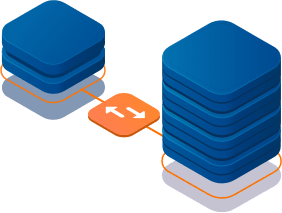
A Brancher is a disposable, exact copy of your Hypernode as it is on production right now–not a staging server commits, versions or features behind. Spin it up via CLI, API or Control Panel. Test safely. Throw it away. Available as an add-on on all Falcon plans.

Production-identical test environments in less than 10 minutes

Testing on staging is “playing fast and loose with the live system”

Peter Jaap Blaakmeer, Elgentos

Read how elgentos uses Brancher

Three problems

Whether you run twenty shops for clients or one of your own, the environment you test on probably isn’t the one you ship to.
One server, everyone’s changes

Multiple feature branches on one shared staging server collide. One developer’s change breaks another’s review, or bleeds into production. Getting several review apps onto one server is awkward at best.

tap to show more

Built by hand, stale on arrival

Setting up a test environment by hand takes anywhere from minutes to days, and it starts drifting from production the moment it exists. Your staging node is already commits, versions or features behind

tap to show more

You pay for it whether you use it or not

A persistent dev node is a fixed monthly subscription, running whether anyone’s testing or not - plus the month-end job of working out which client’s test environment cost what.

tap to show more

Three problems, closed

What you get instead
One node per branch, per client, per test

Each Brancher is its own environment. Nothing another developer does can reach it, and nothing it does can reach production. Spin up as many as you need in parallel.

tap to show more

A real Hypernode, running in under 10 minutes

Full system, real Nginx templates, exposed to the internet exactly as production is - built from your latest backup, so it’s never behind. Nothing to configure by hand, nothing to sync, nothing to clean up. If it works on Brancher, it works in production.

tap to show more

No subscription - switch it off and it stops costing

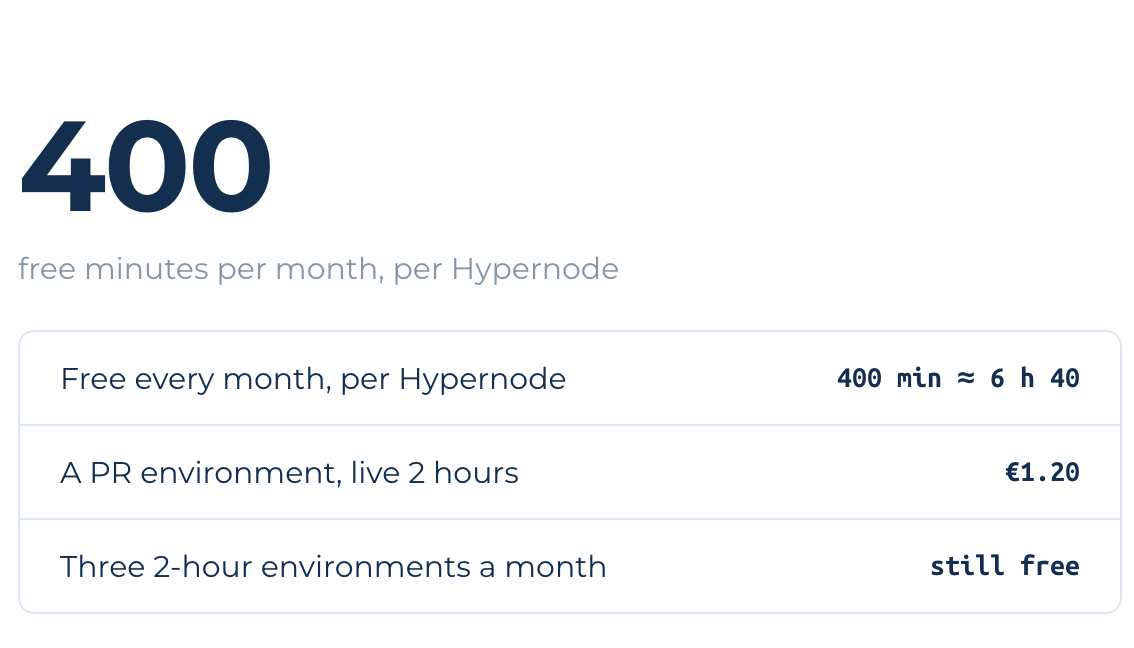
400 free minutes per month per Hypernode, then €0.01/min flat, whatever your plan size. Wire the documented cleanup script into your pipeline and nodes delete themselves once you’re done with them.

tap to show more

Fits the pipeline you already have

1. Control Panel

One click, nothing to install

Create or terminate a Brancher node from your Control Panel. Minutes used, spend, and every past run sit in the same place — so there’s never a mystery line on the invoice.


Read the Brancher docs
Fits the pipeline you already have

Fits the pipeline you already have

Fits the pipeline you already have

1. Control Panel

One click, nothing to install

Create or terminate a Brancher node from your Control Panel. Minutes used, spend, and every past run sit in the same place — so there’s never a mystery line on the invoice.


Read the Brancher docs

2. CLI

One command from your terminal

$ hypernode-systemctl brancher --create
Brancher App created for app 'example'.
app_name: example-eph123456
parent:   example
Host:     example-eph123456.hypernode.io

Add --label to tag it, --clear-services to choose which services’ data comes along, --list and --delete to manage them. There’s an alias, hypernode-brancher, if you’d rather type less.


Full CLI reference

3. API & Deploy

Let the pipeline ask for it

$ curl -X POST -H "Authorization: Token <token>" \
    https://api.hypernode.com/v2/app/<appname>/brancher/

Returns the new node’s name. Client libraries in PHP and Python. Or declare it in Hypernode Deploy and let your test stage create its own node:

$testStage->addBrancherServer('example')
    ->setLabels(['stage=test'])
    ->setSettings(['clear_services' => ['cron', 'supervisor']]);


API reference and Deploy setup

Built for modern agencies
  • Public URLs. Every Brancher node is instantly reachable via a public appname.hypernode.io URL. Share a working feature with a client in seconds – no VPN, no screen share, no deploy to production.

  • Brancher Install Hook. Define your post-provisioning steps once — base URLs, the HTTPS vhost, DB host, payment provider in test mode — and Brancher runs them on boot. The node is usable the moment it’s up.

  • Clean-up you control. The docs include a script that deletes any node past a TTL you set. Wire it into your pipeline and environments remove themselves after a merge.

  • Metadata tagging. Attach a PR number or client name at creation, so parallel environments for different clients stay legible.

  • Choose what data comes along. A Brancher copies your node’s settings and data by default. Pass --clear-services — cron, elasticsearch, mysql, supervisor — to decide which of those arrive empty, so you can import your own anonymised dump instead.

Want to know more?

Use Cases

Four jobs it does every week
One environment per pull request

Your pipeline creates a Brancher node for every PR, comments the public URL on the pull request, and deletes it after merge. Integration tests run in isolation — no shared staging, no collisions, no cleanup. And fewer lines of deployment code to maintain, because you’re adjusting production config rather than rebuilding an environment from scratch.

tap to show more

Risk-free PHP and MySQL upgrades

Some upgrades can’t be undone–like a database upgrade, which hits production with 100% impact. Test the upgrade on a Brancher clone first. It is either confirmed safe or caught as a problem, without any risk to the live shop. While a staging node may be behind production, a Brancher never is.

tap to show more

Client progress reviews

Share a live, fully functioning version of a new feature via a public URL – no VPN, no screen share, no staging conflicts. Your client gets a URL and a login, reviews in their own browser, on their own time, and approves before anything touches production.

tap to show more

Bug replication
Bug replication

Some bugs only show up under production conditions. An exact clone of production makes them straightforward to reproduce: isolate, fix, confirm–without risking the live environment.

tap to show more

Pay per minute

400 minutes free

Every Hypernode on a Falcon plan includes 400 free Brancher minutes per month. Beyond that, you pay a flat €0.01 per minute, regardless of your production plan size, from Falcon XS to 5XL.

Unlike a development node, there is no fixed monthly subscription. Brancher is billed by the minute and can be switched off anytime. After deletion, you receive an overview of the minutes used; active and past runs are visible in the Control Panel, and the total appears as one line on your monthly Hypernode invoice.

Start a Brancher in the Control Panel
Pay per minute

Pay per minute

Pay per minute

Every Hypernode on a Falcon plan includes 400 free Brancher minutes per month. Beyond that, you pay a flat €0.01 per minute, regardless of your production plan size, from Falcon XS to 5XL.

Unlike a development node, there is no fixed monthly subscription. Brancher is billed by the minute and can be switched off anytime. After deletion, you receive an overview of the minutes used; active and past runs are visible in the Control Panel, and the total appears as one line on your monthly Hypernode invoice.

Start a Brancher in the Control Panel

Curious about Brancher? Let us know!

What state is my data in on a Brancher node?

A Brancher is built from your Hypernode’s latest backup, so the state is at most 24 hours old. Need something more recent? Trigger a manual backup on your production node first; that requires SLA Standard.

Does creating a Brancher affect my production node?

No. A Brancher is built from a backup that already exists, so nothing runs against your live node and nothing about it changes. The one exception is if you trigger a manual backup first to get fresher data. That briefly touches production, as any backup does

What stops a forgotten node from running up cost?

Running nodes and the minutes they’ve used are visible in your Control Panel, and the docs include a script that deletes any node past a TTL you set; four hours in the example. Wire it into your pipeline and cleanup stops being something anyone has to remember.

What is the difference between a Brancher node and a development Hypernode?

A development node is persistent. It accumulates stale data, is billed as a fixed monthly subscription, and can be commits, versions or features behind production. A Brancher is the opposite. A copy of production’s latest backup, isolated per branch or client, billed by the minute, and disposable when you’re done.

Can I use a Brancher node as my production environment?

No. And two things would bite you if you tried. Brancher nodes aren’t backed up, and settings you change in the Control Panel don’t apply to them. For production, you need a normal Hypernode. If you’re weighing it up, talk to us.

Is the production database anonymised on a Brancher?

You’re permitted to test with personal data from your production database as long as you dispose of it when you’re done (Arrest C-77/21). If you’d rather anonymise, Masquerade is installed on Hypernode by default, so you can make it part of your deployment strategy.

Can I start a Brancher without my production data?

Yes. A Brancher gets your node’s settings and a copy of its data by default, but –clear-services lets you decide which services arrive empty: cron, Elasticsearch, MySQL, or supervisor. Clear MySQL, and you can import your own anonymised dump instead.

Why does billing start before the node is usable?

The timer starts at creation because the capacity is reserved with the cloud provider from that moment, and we pay for it from that moment too. Brancher is built for short runs. A version upgrade, a test suite, a temporary release. And the cleanup script exists to keep them short.