

Time to First Byte (TTFB) is, from a hosting perspective, one of the most important metrics to keep an eye on. But what exactly makes TTFB such an important metric, and how do you ensure it is properly optimised?
What is Time To First Byte (TTFB)?
Time To First Byte (TTFB) is a metric that measures the response time from an HTTP request until the first byte is received from the web server. The lower the response time, the better. A low TTFB is therefore what you want for your website.
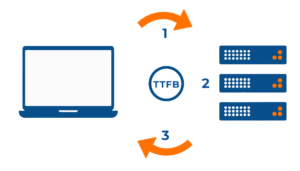
TTFB consists of three elements:
- The time needed for the browser’s request to be sent to the server
- The time the server needs to process the request
- The time it takes for the server to send the first byte back to the browser
How important is a good TTFB?
A good Time To First Byte is important. We believe this as a hosting provider, and Google also recognises its importance, actively highlighting it in tools such as PageSpeed Insights. In this tweet, they even state that it is an excellent way to quantify the quality of your hosting.
The lower the TTFB, the better. Your website becomes visible to visitors more quickly. However, there are differing opinions. For example, Cloudflare stated in 2012 that TTFB is not a relevant end-user metric, and their research even suggested that a higher TTFB had a clear negative correlation with page download time.
Rather than focusing solely on how high or low TTFB is, it is better to look at long-term trends and focus on overall page speed. It’s argued that a good TTFB does not automatically mean you have a fast website, but a poor TTFB is a strong indicator of a slow website.
We agree with this view: a low TTFB is important, but certainly not the only factor that matters. Many elements influence TTFB, and not all are within your control. A fast (low) TTFB is a good indicator of a fast-loading webpage, but it says little about other pages on the same website or webshop.
What is a good TTFB?
Striving for an optimal TTFB for your webshop is something we strongly recommend. While it is partly influenced by external factors such as internet connection speed (with minimal impact), you still have a lot of control.
So what should you aim for?
A TTFB above 0.600 seconds will fail a Google Lighthouse audit. Google considers 0.300–0.500 seconds a “moderate” TTFB, and anything under 0.200 seconds as “good”.
But should you settle for that?
In our opinion, no. A faster TTFB is relatively easy to achieve—provided you know how to optimise it. We believe a good TTFB should not exceed 0.150 seconds.
Does TTFB affect SEO?
Does Google use TTFB as a ranking factor, and does it therefore influence SEO? The answer is no, as confirmed in a tweet by John Mueller (Webmaster Trends Analyst at Google).
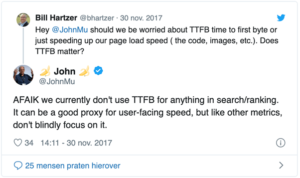
However, site speed is definitely a ranking factor. TTFB can be part of this, but Google does not use it as a standalone ranking signal. One reason for this is that TTFB is heavily influenced by latency (connection delay). Factors such as user location, internet connection, and other external conditions all affect it.
Measuring TTFB
Measuring Time To First Byte is not straightforward. Although there are many tools available, the measured TTFB does not always tell the full story.
We often see TTFB measured on the homepage. In Magento-based webshops, the homepage is usually served from a Full Page Cache, meaning the result is not representative of real performance.
If you want a realistic measurement, we recommend using the shopping cart page with actual products added. This page is typically not cached and is therefore more unique. This gives you a much more accurate picture of your true TTFB.
How do you improve Time To First Byte?
Here are some practical ways to optimise your TTFB:
Use fast DNS
DNS lookup times also affect your TTFB. We recommend not using a free DNS registrar, but instead opting for a premium DNS provider such as Open Provider.
You can test your DNS speed using online tools.
Use caching
Perhaps obvious, but caching has a major impact on TTFB. There is a significant difference between cached and non-cached pages. In some cases, caching can improve TTFB by up to 95%.
Use fast hosting
As mentioned earlier, hosting plays a major role in Time To First Byte. Fast hosting is therefore essential. Hypernode is optimised to keep TTFB as low as possible. Thanks to a well-designed infrastructure, customers benefit from relatively fast response times.
Conclusion
Time To First Byte is a metric that says something about the quality of hosting. However, it is important to note that a good TTFB is heavily influenced by external factors such as internet connection and location.
When measuring TTFB, you should always take into account factors such as location, connectivity, caching, and more. Without this context, you do not get a realistic picture of your website or webshop’s performance.
Although TTFB is not a direct Google ranking factor and therefore does not directly affect SEO, it does impact user experience. If your TTFB is relatively high, it is worth optimising. However, remember that a low TTFB alone does not guarantee a fast website—but a high TTFB is often a strong indicator of a slow one.
Hi! My name is Dion, Account Manager at Hypernode
Want to know more about Hypernode's Managed E-commerce Hosting? Schedule your online meeting.
schedule one-on-one meeting +31 (0) 648362102